
Microsoft isn’t new to conversational AI. So why Contact Center Intelligence, and why now?
If you’ve been following Microsoft’s contact centre journey, you’ll know that conversational AI isn’t exactly new territory.
We’ve had Azure Bot Service and the Bot Framework, Bot Framework Composer, Power Virtual Agents, Nuance and, more recently, Copilot Studio. Each has played a role in Microsoft’s evolving approach to customer engagement and automation.
So when Microsoft introduces Contact Center Intelligence (CCI), it’s reasonable to ask: What’s actually new here?
For me, the interesting part isn’t simply the introduction of another AI experience. It’s what this evolution tells us about Microsoft’s direction and, more importantly, what it means for organisations looking to modernise their contact centres without necessarily replacing their existing platforms or abandoning the AI investments they’ve already made.
Because ultimately, contact centres are still trying to achieve the same objectives they have been pursuing for decades: reduce the total cost of ownership while improving customer satisfaction and delivering greater value.
What’s changing is how we can achieve them.
Let’s dive deeper.
A little history: We’ve been here before
Microsoft has been investing in conversational AI for years.
Azure Bot Service and the Bot Framework provided developers with the infrastructure and tools to build conversational applications. Bot Framework Composer introduced a more visual approach to designing conversations, while Power Virtual Agents made bot development more accessible to business users.
Then came Microsoft’s acquisition of Nuance in 2022, bringing decades of expertise in speech recognition, natural language understanding, voice biometrics and enterprise customer engagement.
Nuance was particularly significant in the contact centre industry. Its technologies helped organisations move beyond traditional touch-tone IVRs towards natural language interactions, more intelligent routing and voice-based authentication.
Meanwhile, Power Virtual Agents evolved into Copilot Studio, and Microsoft continued expanding its customer engagement capabilities with Dynamics 365 Contact Center.
These weren’t all successive replacements. They represented different, sometimes overlapping, layers of Microsoft’s technology stack.
And while the technologies continued to evolve, so did customer expectations.
For years, conversational AI relied heavily on predefined intents, training phrases and entities. These approaches could be extremely effective for well-defined interactions, but became more challenging when customers expressed themselves unexpectedly, changed direction or presented multiple requests in a single conversation.
Think about someone calling their bank:
“I’ve lost my card, I’m travelling tomorrow, and I need to know whether I can still access my money.”
That’s not necessarily one intent. It’s several related needs expressed in a single conversation.
Generative AI creates an opportunity to handle these interactions differently, with agents that can understand context, ask clarifying questions, work across multiple requests and take action.
And that changes the conversation around self-service.
We’ve spent years measuring containment and deflection. How many interactions can we prevent from reaching a human agent?
But a customer abandoning a frustrating bot interaction isn’t necessarily a success, even if the interaction was technically contained.
The real opportunity is moving from recognising customer intent towards resolving customer needs.
That doesn’t mean deterministic conversations disappear. There will always be scenarios where structured, predictable interactions are essential, particularly around authentication, regulated processes and sensitive transactions.
The opportunity is to combine that control with more natural, context-aware conversations.
And Microsoft already has many of the underlying technologies to support this.
But having the technology is one thing. Making it work within an organisation’s existing contact centre environment is another.
The challenge wasn’t always the AI
Contact centres rarely operate in isolation. They’re part of a wider technology landscape, with established platforms, integrations, business processes and operational requirements.
For organisations already using platforms such as Genesys, NICE or Amazon Connect, introducing Microsoft’s conversational AI capabilities hasn’t always been straightforward.
Depending on the platform and architecture, organisations could find themselves working with voice connectors, session border controllers, audio streaming integrations, Azure services or additional middleware to connect their existing contact centre infrastructure with Microsoft’s AI capabilities.
Solutions could be built. And we built them.
But doing so often introduced additional complexity, integration effort and operational overhead.
Even within Microsoft’s own ecosystem, conversational AI was becoming part of a much broader Copilot Studio story.
When Power Virtual Agents became Copilot Studio, the ambition expanded considerably.
Copilot Studio wasn’t simply a tool for building chatbots or voicebots anymore. It increasingly became a platform for creating agents that could retrieve information, automate processes, interact with enterprise systems and execute complex tasks.
That evolution made sense.
But it also introduced an interesting distinction.
Not every AI agent is a conversational AI agent, and not every conversational AI requirement is best served by a general-purpose agent-building experience.
An agent designed to analyse documents, perform research or execute a multistep business process has very different requirements from an agent answering a customer call.
In a contact centre, the conversation itself is the experience.
Latency matters. Interruptions matter. Barge-in matters. Authentication matters. Escalation matters.
The ability to maintain context, understand multiple requests, complete transactions and recognise when human intervention is required matters.
And beyond the interaction itself, contact centres need ways to test, evaluate and improve these experiences against meaningful operational outcomes.
This is where a more purpose-built approach becomes interesting.
Enter Microsoft Contact Center Intelligence
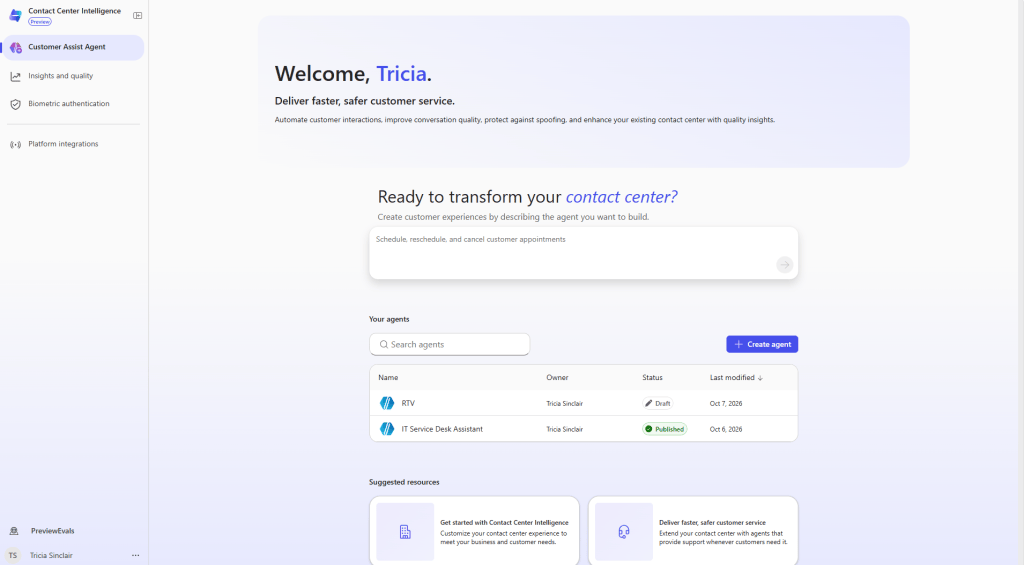
CCI isn’t about Microsoft starting again.
I see it as an evolution of the conversational AI capabilities Microsoft has been developing for years, brought together through an experience more deliberately focused on customer engagement.
Rather than starting with a general-purpose AI agent and adapting it for customer conversations, CCI starts with the requirements of conversational AI.
Think voice and digital self-service, knowledge, authentication, skills, tools, connected agents and the ability to design and evaluate complete customer interactions.
The value isn’t necessarily that every underlying capability is new.
It’s that those capabilities can be brought together in a way that makes more sense for the people building and operating conversational AI.
And that distinction becomes clearer when we look at the authoring experience.
What’s different about the new experience?
Microsoft already provides several ways to build AI agents, including the standard Copilot Studio experience, its GitHub Copilot harness and Microsoft Foundry.
So what changes when we introduce an experience specifically designed around customer conversations?
For me, the differentiation isn’t simply about creating another agent.
It’s about making the capabilities needed for conversational AI easier to design, orchestrate, test and manage.
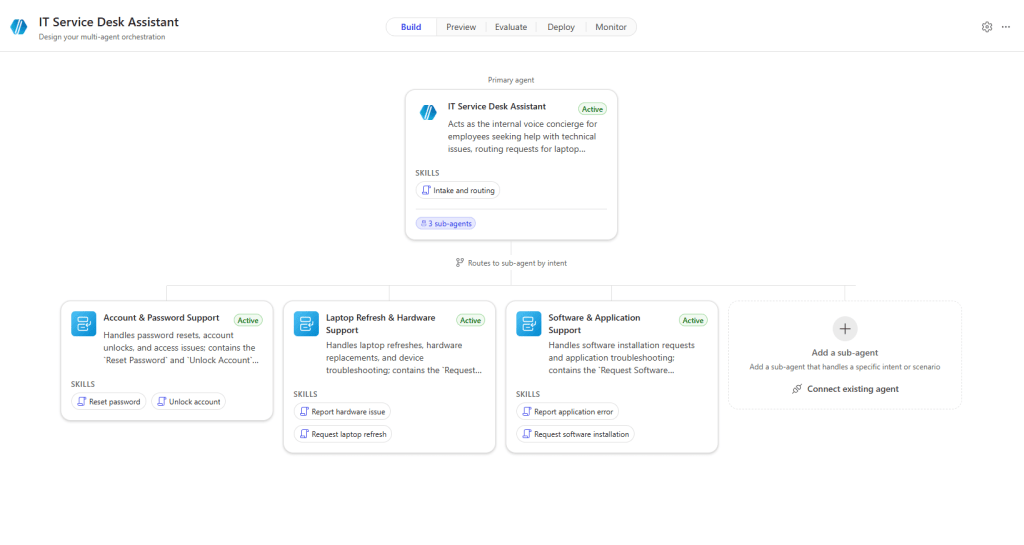
Take conversational design.
With generative AI, we have more flexibility in how agents understand requests and determine what to do next. But that doesn’t mean topics and deterministic flows are no longer relevant.
In many contact centre scenarios, we need both.
An agent might use generative capabilities to understand what a customer wants, invoke a specialised skill to retrieve information and then follow a deterministic process to complete an authenticated transaction.
It may need to delegate a task to another agent, use enterprise knowledge or transfer the interaction to a human.
The experience needs to remain coherent throughout.
And ideally, the authoring tools should make those different components easier to understand, configure and manage.
Then there’s testing.
Testing whether an agent answers a single question correctly is useful. But contact centres need to understand what happens across an entire conversation.
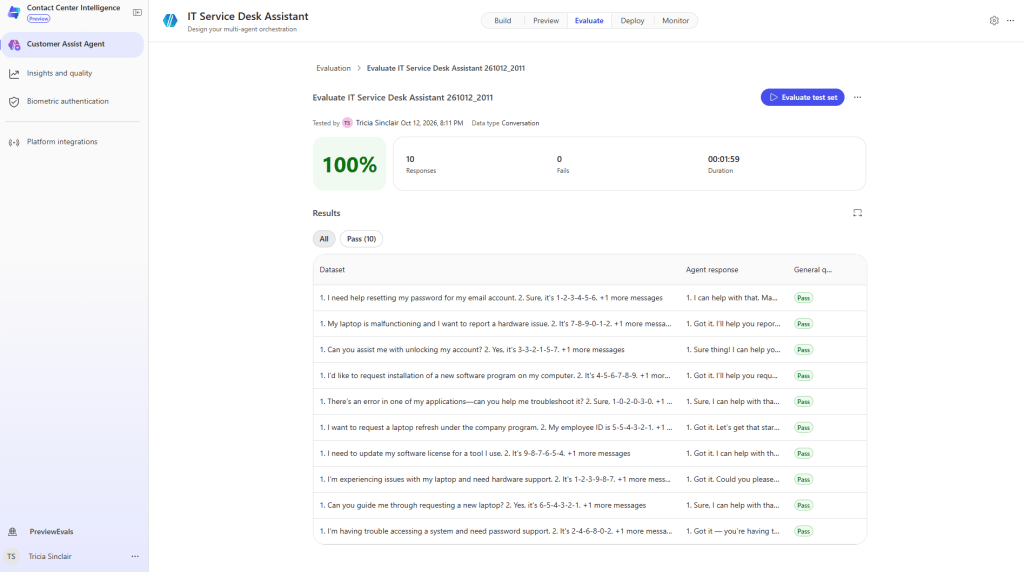
What happens when the customer changes their mind halfway through? What if they ask several questions at once? What if authentication fails? What if the agent needs to transfer the interaction?
This is where multi-turn evaluations become particularly important.
So do analytics that reflect the outcomes contact centres actually care about, such as successful resolution, containment, escalation, customer effort and knowledge effectiveness.
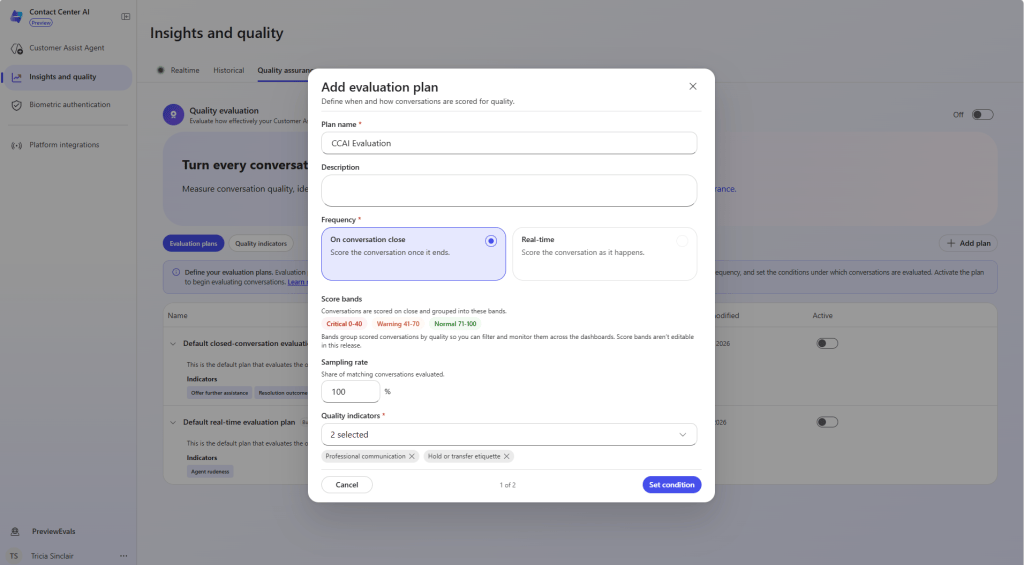
These aren’t entirely new concepts. Several capabilities already exist across Copilot Studio and Microsoft’s broader AI ecosystem.
What matters is whether CCI makes them easier to use together, with an experience designed around the realities of customer conversations.
And that’s where I think the new authoring experience deserves a closer look.
Bringing Microsoft AI into the wider contact centre ecosystem
One of the aspects of CCI that I find particularly interesting is its relevance beyond Dynamics 365 Contact Center.
And there’s an important distinction to make here.
Dynamics 365 Contact Center is Microsoft’s contact centre platform. It provides capabilities such as routing, queues, agent experiences, supervisor tools and contact centre operations.
CCI focuses on the AI capabilities that can support customer interactions.
Those are two different architectural responsibilities.
For an organisation using Dynamics 365 Contact Center, the relationship between the contact centre platform and Microsoft’s conversational AI capabilities may be relatively straightforward.
But what about an organisation using Genesys Cloud, NICE CXone or Amazon Connect?
That’s where the wider opportunity becomes interesting.
An organisation might want to retain its existing CCaaS platform while introducing Microsoft conversational AI to handle selected customer journeys.
For example, Genesys could continue to manage telephony, queues, routing and the human agent experience, while a Microsoft-built conversational agent handles an initial self-service interaction.
The AI agent might authenticate the customer, retrieve information, complete a transaction or determine that the interaction needs to be escalated.
If escalation is required, the architecture needs to support transferring the customer, along with the relevant context, back into the contact centre platform.
The same general approach could apply to NICE, Amazon Connect or another CCaaS platform, although the technical integration model and supported capabilities will differ.
This is not about CCI taking over every function of the contact centre.
It’s about understanding which platform is responsible for which part of the customer journey.
The CCaaS platform may continue to own routing, workforce management, recording, quality management and the agent desktop.
Microsoft AI may provide conversational understanding, knowledge, orchestration, specialised skills or automated resolution.
And existing agents built using Azure or Copilot Studio may still have a role to play, depending on the available integration and orchestration options.
The choice of conversational AI technology doesn’t have to be the same decision as the choice of contact centre platform.
For organisations, this creates an opportunity to introduce new AI capabilities while building on their existing contact centre investments. Whether that’s improving self-service, enabling more complex customer journeys or reusing agents they’ve already developed, the focus can remain on delivering better customer experiences rather than replacing the underlying platform.
And that’s what makes this evolution particularly interesting.
My take: It’s about making AI fit the conversation
For years, we’ve been adapting AI technologies to meet the needs of contact centres.
With CCI, I see Microsoft taking a more deliberate step towards adapting the AI-building experience to the needs of customer conversations.
That’s an important distinction.
We’ve reached a point where the conversation shouldn’t simply be about whether AI can understand a customer’s request or generate a natural-sounding response.
It needs to be about whether AI can help resolve that request, securely, consistently and at scale.
And whether organisations can build and operate those experiences without introducing unnecessary complexity.
The success of CCI won’t be measured by how many agents organisations create or how quickly they can publish a bot.
It will be measured by how effectively those agents resolve customer needs, how easily they integrate into existing environments and whether they can be managed and improved at enterprise scale.
It will also depend on whether the experience genuinely reduces the complexity and cost of delivering conversational AI.
Because ultimately, we’re still trying to achieve the same objectives we started with: reducing the total cost of ownership while improving customer satisfaction.
What’s changing is our ability to deliver on those objectives.
And for me, that’s what makes CCI worth paying attention to.
The real opportunity isn’t simply bringing more AI into the contact centre. It’s making AI fit the conversation, the customer journey and the contact centre environment that organisations already have.

